forbes.pl: A crisis is the most serious test of a company's strength of spirit, creativity and efficiency
 2020-04-06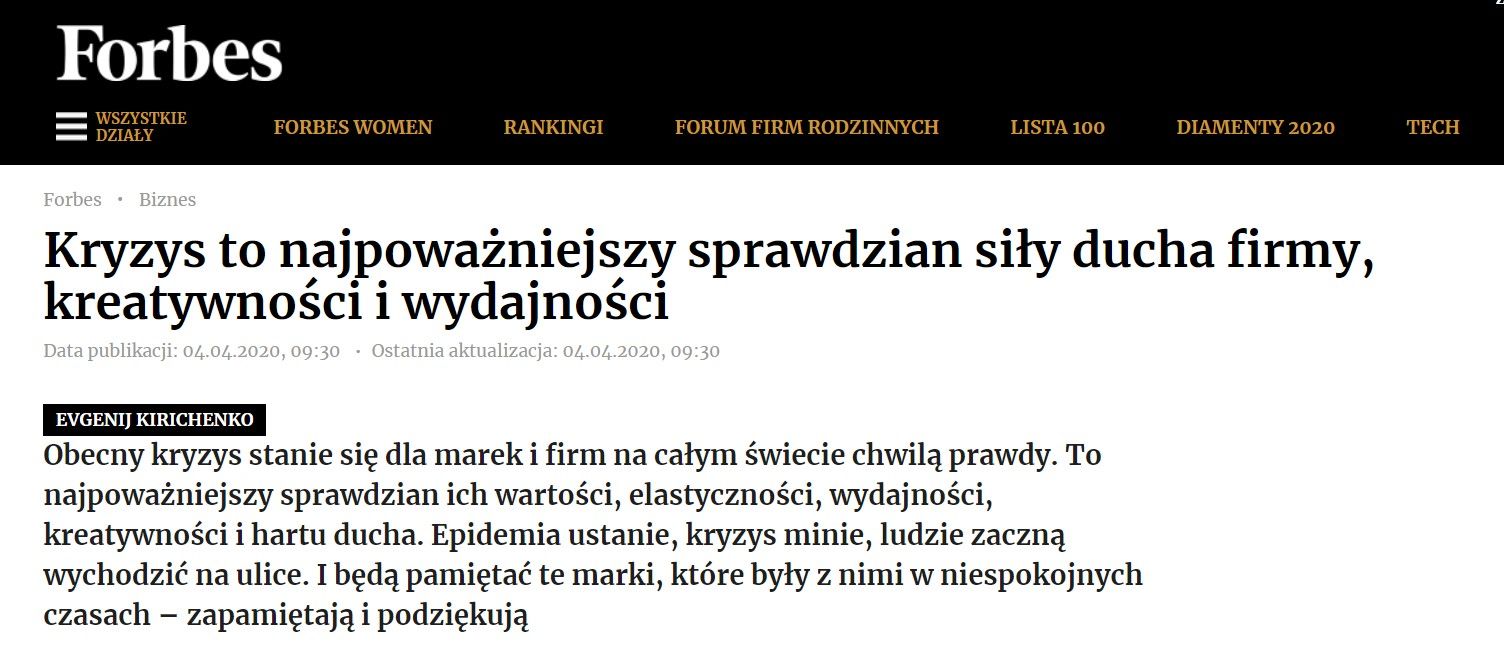
Evgenij Kirichenko: A crisis as the most serious test of a company's strength of spirit, creativity and efficiency.
The current crisis will be a moment of truth for brands and companies around the world. It is the most serious test of their values, flexibility, efficiency, creativity and fortitude. The epidemic will subside. The crisis will pass. People will start going out into the streets. And they will remember the brands that were with them in troubled times. They will remember and be grateful. Drawing on my own business experience, let me put forward a number of ideas and tips that may be useful for other companies to survive this crisis while believing in themselves.
BE MORE ACTIVE THAN YOUR COMPETITORS
At this moment, no one knows when and how the economic cataclysm that has engulfed the entire planet along with the coronavirus pandemic will end. Not a single company has a perfect recipe for surviving this period. It seems the world has gone mad. But even in the worst crisis, the most unexpected windows of opportunity open. And the most important thing is not to miss this moment. At Gremi Personal, we believe that during a crisis one must not stop advertising and PR activities. Those who are heard and seen have more opportunities to attract attention and stick in customers' memory. And this gives a chance to survive and quickly emerge from the crisis. McGraw-Hill studied the recession in the United States in 1980–1985. The company surveyed more than six hundred enterprises providing B2B services. It turned out that the companies that continued advertising during the 1981–82 recession, by 1985, increased their turnover by 256% compared to competitors who cut spending or stopped investing in advertising. American Business Press studied the activities of 143 companies during the 1974–75 recession. The companies that advertised at the time showed the highest growth in sales and net income during the recession and over the following two years.
Advertising during a recession is always the right tactic for a company's development at the moment and in the future. It is not as risky as it might seem. When competitors save on advertising, you get a chance for customers to turn to you. By advertising in good times and bad, you take bread from your competitors. At the same time, of course, forget about expensive and pompous advertising. It is time for creative and inexpensive PR, fast and bold ideas. The time is coming for proper and targeted online advertising.
TALK TO CUSTOMERS AND THE MARKET
A crisis is a time of fear. And in an atmosphere of fear, panic and false information spread very efficiently. That is why it is important for a company to talk to partners and customers. Conveying official information, debunking myths, and preventing information panic is crucial. It is also important to talk about the good things happening today. Cheer up your customers, and they will repay you with their loyalty.
However, if you do not fight panic and fake reports at least in your own market, it will reduce your chances of survival. This must also be done with regard to your employees. Let me give an example from the experience of our company, which is engaged in outsourcing (labour leasing). Among our 2,000 workers, the majority are Ukrainians. On the eve of the closure of the Polish-Ukrainian border on 27 March, panic arose among many Ukrainians working in Poland. It concerned information that they would not be able to return to Ukraine for a long time and that the borders would be completely closed. Many decided they had to drop everything and leave immediately. This caused a massive outflow of Ukrainian workers. On average, 12% of Ukrainians left the labour market within 10 days. Meanwhile, only 5% of our workers left during that time. We started an information campaign among workers early, informing them that the borders would be closed to air and rail traffic but that the border could be crossed by car at any time. We also created two quarantine centres for those Ukrainians who had already left and planned to return to Poland but had to undergo a 14-day quarantine for this. We explained in detail, step by step, that the Polish government had decided to automatically extend residence and work permits for foreigners and that they need not worry about the legality of their stay and employment. This helped keep people from making rash decisions.
ANALYSE DURING A CRISIS
Start analysing now what the world will look like after the next crisis. For example, the consequences of the 2008 crisis were the "conscious consumption" trend and the growth of micro-enterprises. In the last crisis, the companies that survived were those that were flexible and quickly transformed their structure, staff, budget, customer base, and advertising and PR tactics. As for our business, we learned an important lesson from previous crises – we diversified our customer base. Even in times of stability, we did not focus on one large client but on a large number of medium-sized companies, which helped us greatly. Now, when a new crisis has erupted, we were able to react very quickly. Our clients in the hospitality and restaurant industry keenly felt the effects of the epidemic outbreak. And so we redirected the workers laid off from these sectors to work in manufacturing and logistics companies.
BE HONEST WITH YOUR EMPLOYEES
As a company owner, I understand perfectly well that the first impulsive solution during a crisis is to cut staff or carry out mass layoffs. However, mindlessly firing workers just to temporarily save money is a bad strategy. As a result, you will be left without workers and without funds. It is more reasonable to audit the team with an emphasis on each worker's effectiveness and the possibility of increasing their multitasking and flexibility in crisis situations. In a crisis, every effective and motivated worker matters. And if you spot such workers, do everything in your power to keep them. However, so that workers' motivation does not fall, communicate with them more often, honestly justify your unpopular decisions, such as reducing salaries, cancelling social packages, etc. "In dark times, bright people are very clearly visible." And bright people (your motivated and productive workers) will appreciate your sincerity and honesty and will not leave you.