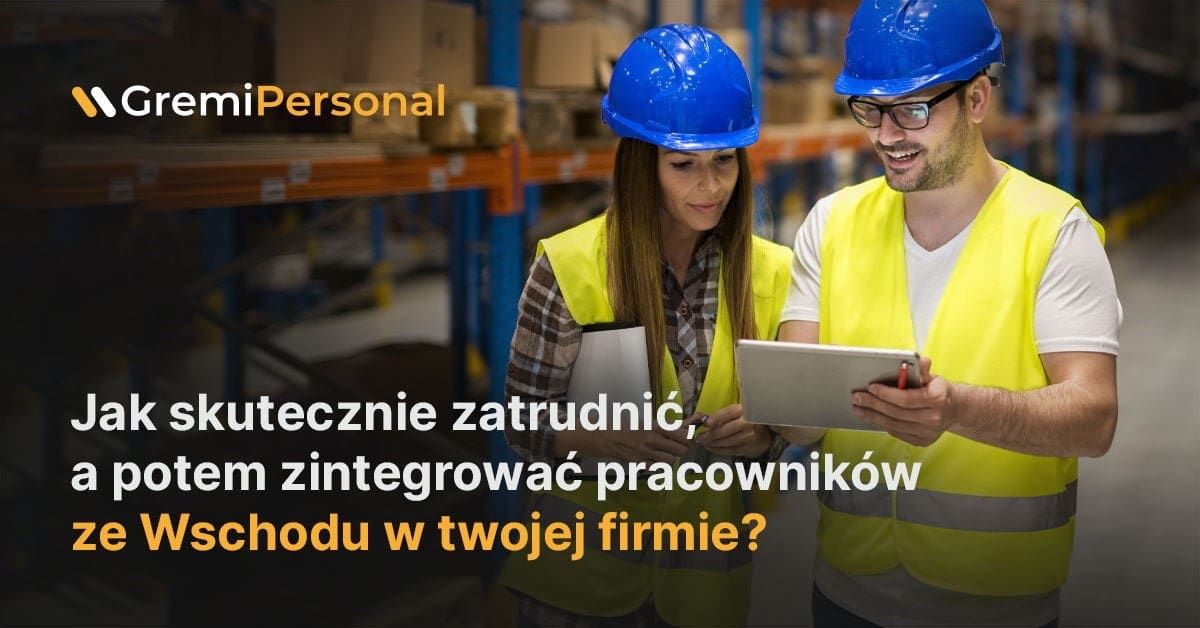
How to Effectively Hire and Then Integrate Eastern Workers in Your Company?
Offering Language Support
One of the main challenges when recruiting workers from outside the region is the language barrier. A study we conducted together with Gdansk University of Technology indicates that over 60% of surveyed Ukrainian citizens working in Poland are not working in their field of qualification due to a lack of language skills. For this reason, it is worth offering language support in the form of courses or foreign language lessons. By supporting employees in learning the local language, we enable them to communicate better with their colleagues and carry out their duties more effectively.
A significant advantage is also having managers who speak the language of new employees, though relatively few companies enjoy this luxury. In such situations, a multilingual coordinator or client supervisor can prove invaluable. That is why clients of Gremi Personal always have access to such specialists who, thanks to years of accumulated experience, effectively support the integration of employees in their new workplace.
Support in Legalizing Residence
Support in legalizing the residence of new employees is a key element of a foreign worker recruitment strategy. This process involves assistance with all formalities related to obtaining visas, work permits, and other necessary documents that allow employees to legally reside and work in the country. Effective support in this area not only facilitates employees' adaptation to a new environment but also prevents legal problems that may arise from documentation errors. As a result, employers can focus on integrating new team members and their productivity at work, rather than on bureaucratic obstacles.
Legalizing the residence of foreigners also entails ensuring compliance with local immigration regulations. Companies that benefit from the support of an experienced partner such as Gremi Personal can be confident that the international recruitment process runs smoothly and in accordance with applicable standards. Moreover, this builds a positive employer brand as an entity that genuinely cares for its employees, which is important in the context of positioning the company as an attractive place to work. Employees who feel supported by their employer are more likely to commit to long-term cooperation and demonstrate greater loyalty to the company.
As a result, support in legalizing residence not only facilitates the smooth integration of foreigners in the workplace but also represents an investment in the development and stability of the business. Organizations that engage in this process can count on benefits such as greater team diversity, enrichment of organizational culture, and increased innovation and creativity - all of which are invaluable in a rapidly changing global labor market.
A Smooth Employee Onboarding Process
Recruiting workers from abroad is just the first step; the next is to carry out an onboarding process that allows the newly hired employee to start work quickly and effectively. A well-organized onboarding of a new employee is of great importance in any recruitment process. After all, every company wants its new hires to deliver full business value as quickly as possible. In the case of foreigners, this process can be somewhat more challenging - as it often involves not only finding one's footing in a new workplace, but also in a new country and a completely different environment.
There are many ways to support this process. For example, one can arrange for an interpreter to be present during the first days of new employees at the company, or prepare educational and onboarding materials in the language of the employees. All documentation must also be maintained in a language that employees can understand.
Clients of Gremi Personal do not need to worry about this - our company supports the onboarding process of new employees and ensures that it proceeds smoothly and without problems. Our experienced supervisors have guided many companies through such situations and know exactly how to help employees adapt to new conditions.
Adapting the Work Environment
It is also worth adapting the work environment to the needs of employees from abroad. This can include, for example, offering traditional dishes from their cuisine, providing access to products and media popular in their home countries, or incorporating their holidays and traditions into the company calendar. This helps employees feel more valued and integrated in their new workplace.
The examples mentioned may seem rather trivial, but they are important elements that create positive experiences in a new workplace. In this way, with relatively little effort, it is possible to speed up the integration process of Eastern workers and support the company's positioning as an attractive employer.
Integration Through Out-of-Work Activities
Organizing shared activities - such as lunches, family picnics, trips to the city, or team-building events - can significantly contribute to the integration of workers from Eastern Europe and beyond. Creating opportunities to get to know each other outside of work and after working hours fosters the building of relationships and trust within the team. At Gremi Personal, we are very proud of our Borshch Festival, which many of our employees participate in. During this event, we celebrate Ukrainian culture and raise funds for a worthy cause, which also supports integration and a sense of community within our team.
Another example of such activities is sports and recreational events, especially team sports. Playing football, basketball, or volleyball together is excellent for building team spirit. Of course, sports will not suit every company, but when they meet with enthusiasm from employees, they lead to the creation of a cohesive community. In situations where a company already has such out-of-work activities, it is key that every employee feels welcome to participate.
It is also worth remembering that employee integration can take many forms, so it is worth finding out exactly what the employees of a given company expect. Responding to employees' needs will be far more effective in building a cohesive team and positive relationships than a vision imposed without consultation with anyone.
Training and Understanding Cultural Differences
The last, but no less important, element of effective integration of Eastern workers is training on cultural differences. These training sessions apply to both new and existing employees. They should be aware of differences in approaches to work and communication, which will help avoid conflicts and misunderstandings.
A fundamental step in the process of integrating Eastern workers is understanding their culture and the differences in their approach to work and professional life. An excellent idea is to familiarize oneself with the social norms, customs, and expectations of employees from these regions. Understanding these differences enables effective communication and the building of relationships with new employees. All of this translates into a smooth integration of new team members and the rapid creation of value for the business - which is why it should matter to employers.
Integrating New Eastern Workers
In summary, effective hiring and integration of Eastern workers in a company requires both an understanding of their culture and appropriate support and adaptation of the work environment. Investment in these areas can bring numerous benefits, including improved team atmosphere, increased employee loyalty, building a reputation as an attractive employer, and growth in company productivity. Strong practices in this area support the recruitment process and the achievement of business goals.
At Gremi Personal, we comprehensively support companies in recruiting and onboarding Eastern workers. More than 400 clients have already trusted us, and our experienced, international team thoroughly understands the needs of foreign workers and knows how to address them. Contact us and use our know-how to enjoy a seamless integration of Eastern workers:
https://gremi-personal.com/oferta/


 2026-08-24
 View
View