Employee sobriety testing - can and how may an employer test with a breathalyzer?
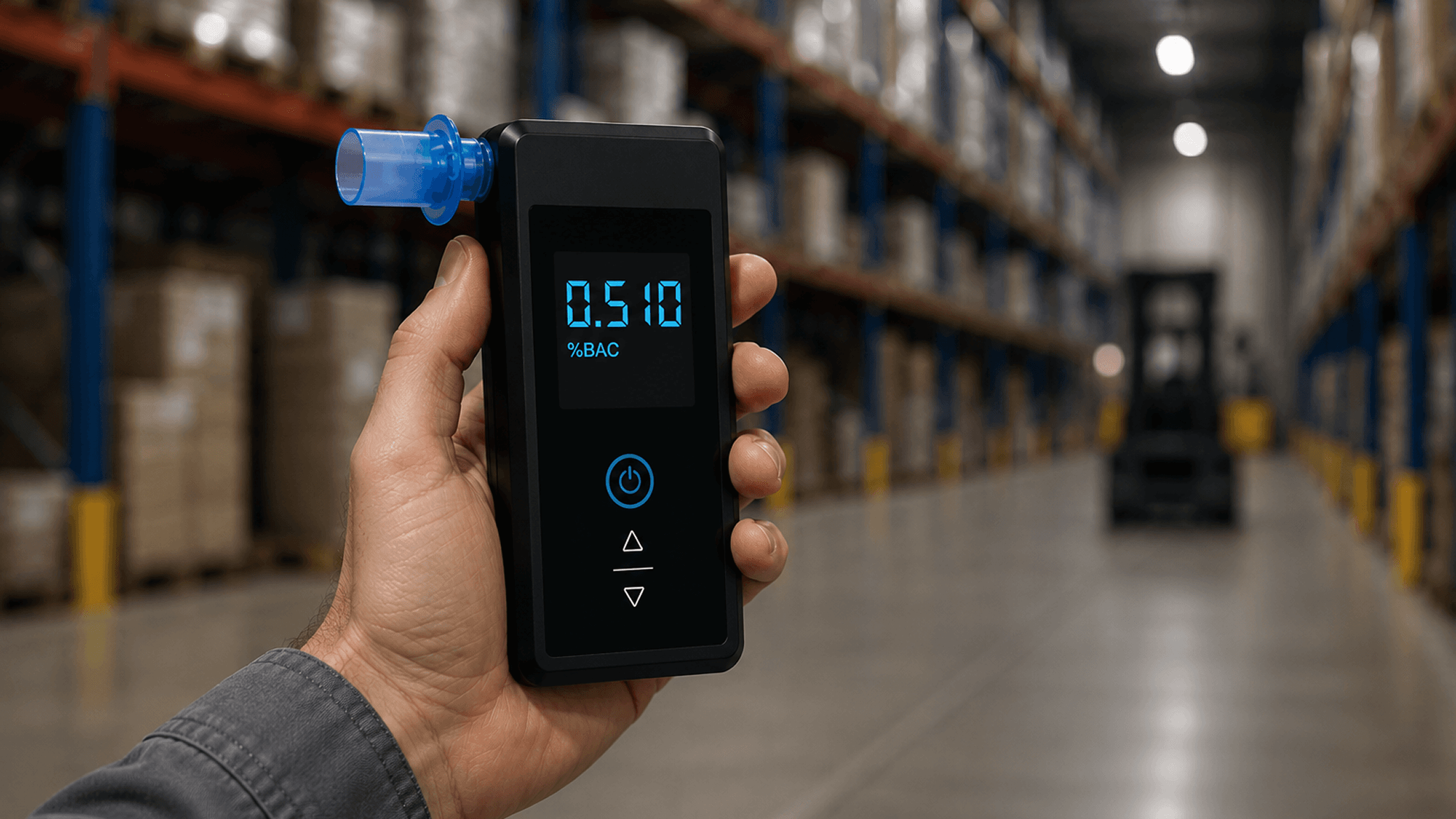
The question of whether an employer can test employees with a breathalyzer comes up in many companies whenever there is a suspicion that someone has come to work under the influence of alcohol. Since February 2023, the answer has been clear: yes, but under specific conditions. The topic applies not only to manufacturing or transport, where the safety stakes are obvious, but also to offices, warehouses and shops, where the employer is responsible for staff safety just as much as in a factory. We explain who can check an employee's sobriety, what the step-by-step procedure looks like, and what an employer may not do even when there is a justified suspicion.
Sobriety testing at work - since when and on what legal basis?
Since 21 February 2023, the Labour Code has directly regulated this issue in Article 221c. Under this provision, if it is necessary to protect the life and health of employees or other persons, or to protect property, the employer may introduce sobriety testing of employees. Before that date, the employer had no legal basis to carry out breathalyzer testing on their own - they could only call the police, who had exclusive authority to carry out such actions. Random testing of employees without a legal basis previously constituted a violation of their personal rights. Today, the employer can carry it out themselves, but must strictly follow a clearly defined procedure that protects both sides: the employee from arbitrary treatment, and the employer from accusations of breaking the law.
Who can check an employee's sobriety?
Sobriety testing can be carried out by the employer themselves or by a person designated by them, provided the company has introduced an appropriate internal procedure. However, this requires that the testing rules first be set out in a collective agreement, work regulations, or an announcement, if the company is not required to have work regulations (this applies to employers with fewer than 50 employees). Without such a document, the employer cannot introduce preventive, random testing - even if they declare good intentions. Alternatively, in a situation of justified suspicion, the police can be called to test the employee, as they have authority independent of the company's internal regulations and can carry out testing even where the company has not implemented its own procedure.
What must the sobriety testing procedure include?
Breathalyzer testing at work - the law requires that the document introducing the testing specify the groups of employees covered by testing, the method of conducting the testing (type of device, frequency, hours), the rules for processing personal data, and the retention period for results. Employees must be informed of the introduction of testing at least two weeks in advance, and a newly hired employee covered by the testing must receive this information before being allowed to work - no later than within 7 days of being hired, according to current practice. Testing may not be discriminatory in nature (for example, only selected individuals may not be tested without justification related to their position) and must be carried out with respect for the employee's dignity - in a place that ensures discretion, without publicly announcing the results.
How many per mille disqualifies someone from work?
The Labour Code does not use the term "per mille" but refers to two states: the state after alcohol consumption (from 0.2 to 0.5 per mille in the blood or correspondingly in exhaled breath) and the state of intoxication (above 0.5 per mille). Both states disqualify an employee from being allowed to work, and the state of intoxication may additionally result in liability under the Code of Petty Offences. The same applies to substances that act similarly to alcohol - the list of such substances is set out in the implementing regulation to the Labour Code.
What happens when the result is positive?
If a breathalyzer test shows that the employee is in a state after alcohol consumption or in a state of intoxication, the employer is obliged not to allow them to work. The same applies to a situation where there is a justified suspicion but the test cannot be carried out (for example, the employee refuses or their condition does not allow the breathalyzer test to be performed). An employee suspended from work may request a blood test if they dispute the breathalyzer result - in that case, they bear the cost of the test unless the result turns out to be negative. Information about the testing carried out and its result is entered into the employee's personnel file, but only for a specified period - as a rule, no longer than one year from the date it was carried out, unless it constitutes evidence in proceedings, such as disciplinary or court proceedings.
Consequences for the employee in case of repeated violations
Showing up to work in a state after alcohol consumption or after using a substance with similar effects may result not only in being denied work, but also in a disciplinary penalty (reprimand, warning, monetary fine) - provided that such grounds have been written into the work regulations. In more serious or repeated cases, the employer may consider terminating the contract without notice through the employee's fault, provided the violation was serious in nature and endangered safety at the workplace.
FAQ
1. Can an employer test with a breathalyzer without the employee's consent?
Yes, provided the company has introduced a formal sobriety testing procedure in the work regulations, collective agreement, or announcement. Without such a basis, the employee's consent is required.
2. Who besides the employer can check an employee's sobriety?
The police - in any situation of justified suspicion, regardless of whether the company has introduced an internal testing procedure.
3. Sobriety testing at work - since when has it been in force?
Since 21 February 2023, under the amendment to the Labour Code introduced by the act of 1 December 2022.
4. What if an employee refuses a breathalyzer test?
The employer does not allow them to work due to justified suspicion. The employee can request a blood test as an alternative if they dispute the grounds for being denied work.
5. How long are sobriety testing results kept?
As a rule, no longer than one year from the testing date, unless the information constitutes evidence in proceedings - in which case the period is extended until their final conclusion.
6. Can a small company without work regulations introduce sobriety testing?
Yes - if the company is not required to maintain work regulations (fewer than 50 employees), the testing rules are introduced in the form of an announcement, which serves an equivalent function.
Want to implement a legally compliant sobriety testing procedure at your company? Gremi Personal can advise on how to formulate and introduce it correctly.


 2026-08-24
 View
View