Unused Leave of a Temporary Worker in Poland: When Compensation Is Due
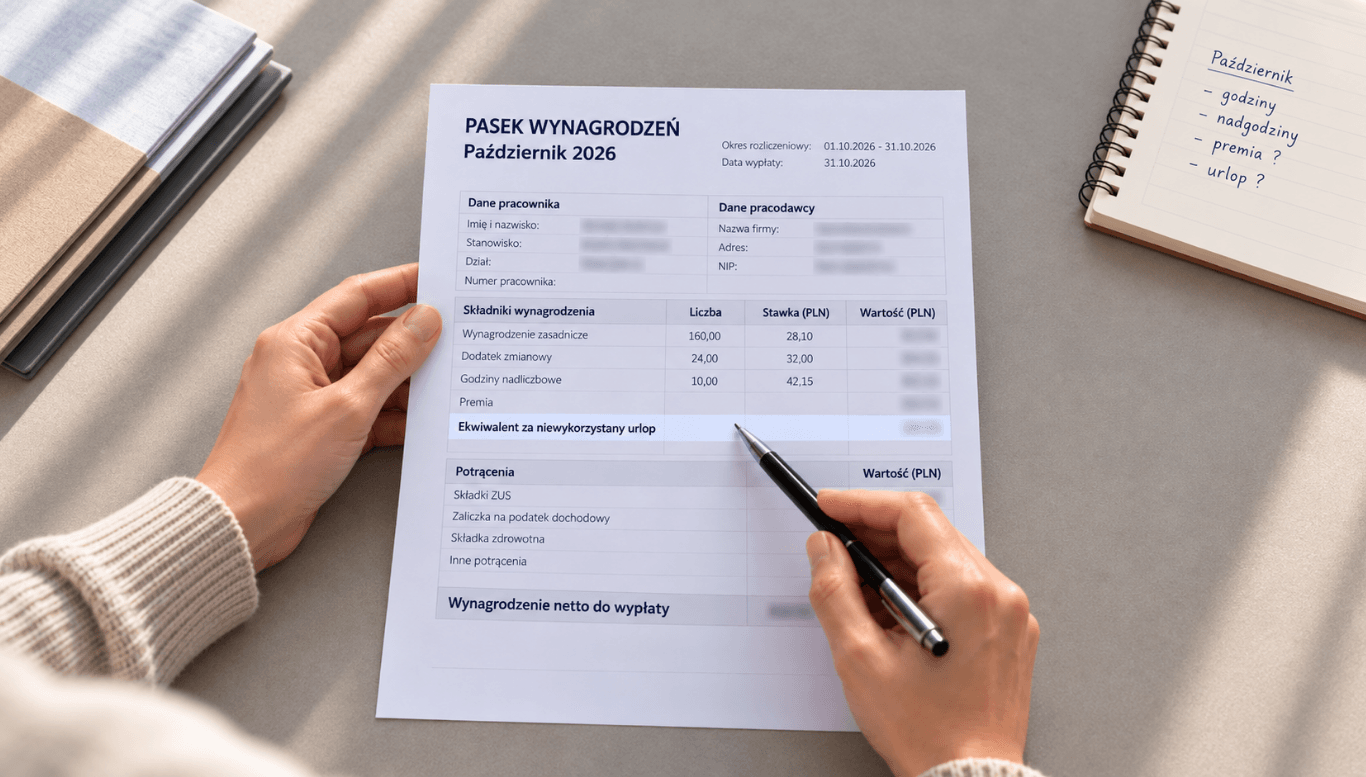 When looking for work in Poland, candidates typically focus on the hourly rate, the number of shifts and the opportunity to earn more through additional hours. Sometimes, however, even when the employment agency has paid for all hours worked, the final payment turns out to be lower than expected. One reason may be an unpaid cash equivalent for unused annual leave (ekwiwalent za niewykorzystany urlop).
Temporary workers employed under an employment contract (umowa o pracę) are entitled to annual leave. If it has not been taken, the agency is generally required to pay a cash equivalent (ekwiwalent pieniężny). If this equivalent is not paid within the statutory deadline and there is no lawful basis for withholding it, the worker's rights have been violated.
When the Agency Is Required to Pay the Leave Equivalent
Under Article 17 of the Polish Act on Temporary Employment, a temporary worker is entitled to two days of leave for every month spent in the service of one or more user employers. If the worker has not taken their leave during the period of temporary work, the agency is required to compensate for the unused days and pay a cash equivalent.
This is a special provision applying specifically to temporary workers. The general rules on annual leave entitlement, which depend on length of service, should not therefore be applied to them automatically. Nor can the number of days due be determined solely on the basis of shifts worked. What matters is the period during which the worker remained in the service of the employer.
Leave is also not accrued again for any period for which the worker has already taken leave on another basis.
There is one exception. The agency is not required to pay the equivalent if the parties have agreed that the leave will be taken during the next employment contract with the same agency, to work for the same user employer with whom the worker was employed immediately before the termination of the previous contract.
Payment Deadlines
The question of deadlines deserves separate attention. From 27 January 2026, the Polish Labour Code explicitly sets out the deadlines for paying the cash equivalent for unused leave following the termination of an employment relationship.
As a general rule, the equivalent is paid on the standard salary payment date. If that date falls before the termination of the employment relationship, the equivalent must be paid within 10 days of that termination.
Knowing these rules is important, as an underpayment is not always obvious. A worker may receive the full amount for hours worked and conclude that they have been paid in full. After finishing work, it is therefore worth checking not only the wage amount but also the number of leave days accrued and taken, and establishing whether there was a legal basis for deferring payment of the equivalent.
The scale of the problem with outstanding payments in Poland is considerable. In Silesian voivodeship alone, PIP (Państwowa Inspekcja Pracy - the National Labour Inspectorate) recorded 344 cases concerning the non-payment of the leave equivalent in 2025. These figures cover various employers, not only agencies, but once again confirm that the problem is a real one.
What to Do If the Final Payment Is Short
If you received less than expected after finishing work, you should not immediately accept the agency's explanation that "everything has already been paid" or that no equivalent is due after the contract has ended. First, check whether the final settlement actually covers all payments provided for by the contract and the law.
Points to pay attention to:
First - the agency does not explain how many leave days were accrued and how many were taken. Without this information, it is difficult to verify whether the final amount has been correctly calculated.
Second - you are not provided with a clear breakdown. If the agency does not explain how the final payment was calculated, you are entitled to request a detailed statement. The absence of a separate line item in a bank transfer does not in itself constitute proof of a violation.
This does not have to be a deliberate scheme. Sometimes the cause is an error, but verifying the settlement is always advisable.
How to Proceed Step by Step
First, check the type of contract. The specific leave guarantees and the right to a cash equivalent apply to a temporary worker employed under an employment contract (umowa o pracę). Under a civil law contract (umowa zlecenia), the right to leave and to a cash equivalent under the Labour Code generally does not apply.
Next, compare the days due with the days taken. Check the employment period, the number of leave days accrued and how many you actually took.
Ask the agency for a written explanation of the final settlement. Ask whether the equivalent was calculated, how its amount was determined or on what basis it was not paid. If the agency refers to an agreement to use the leave during the next contract, ask for confirmation of the relevant terms.
Keep your documents. The contract, pay slips, payment confirmations and correspondence will help establish whether your rights have been violated.
If the agency does not respond, fails to explain the calculation or refuses to pay the amount due, you may contact PIP or a labour court (sąd pracy).
When choosing an agency, always look beyond the rate and the schedule. Find out in advance what type of contract is being offered, how leave is recorded and how the final settlement is conducted. If the answers are unclear or the terms change after work has begun, it is better to clarify everything before signing the contract.
For information on current Gremi Personal vacancies and employment conditions, call: +380 50 334 93 51, +48 525 275 003.


 2026-10-20

 View

