The EU Residence Card in Poland: What This Status Offers Those Planning to Stay Long-Term
 If you have been living and working in Poland for several years, the question eventually arises: how can you secure more stable conditions of residence for the future? Temporary permits have a limited validity period, and obtaining each subsequent one requires repeated confirmation of the relevant grounds.
One possible solution is EU long-term resident status. It is frequently confused with permanent residence (pobyt stały), although these are two separate permits with different conditions for obtaining them. EU resident status is intended for foreign nationals who have resided legally in Poland for an extended period, have a stable source of income and meet other requirements established by law.
Let us examine what rights this status confers, who it may be suitable for and what to consider before submitting an application.
What EU Long-Term Resident Status Is
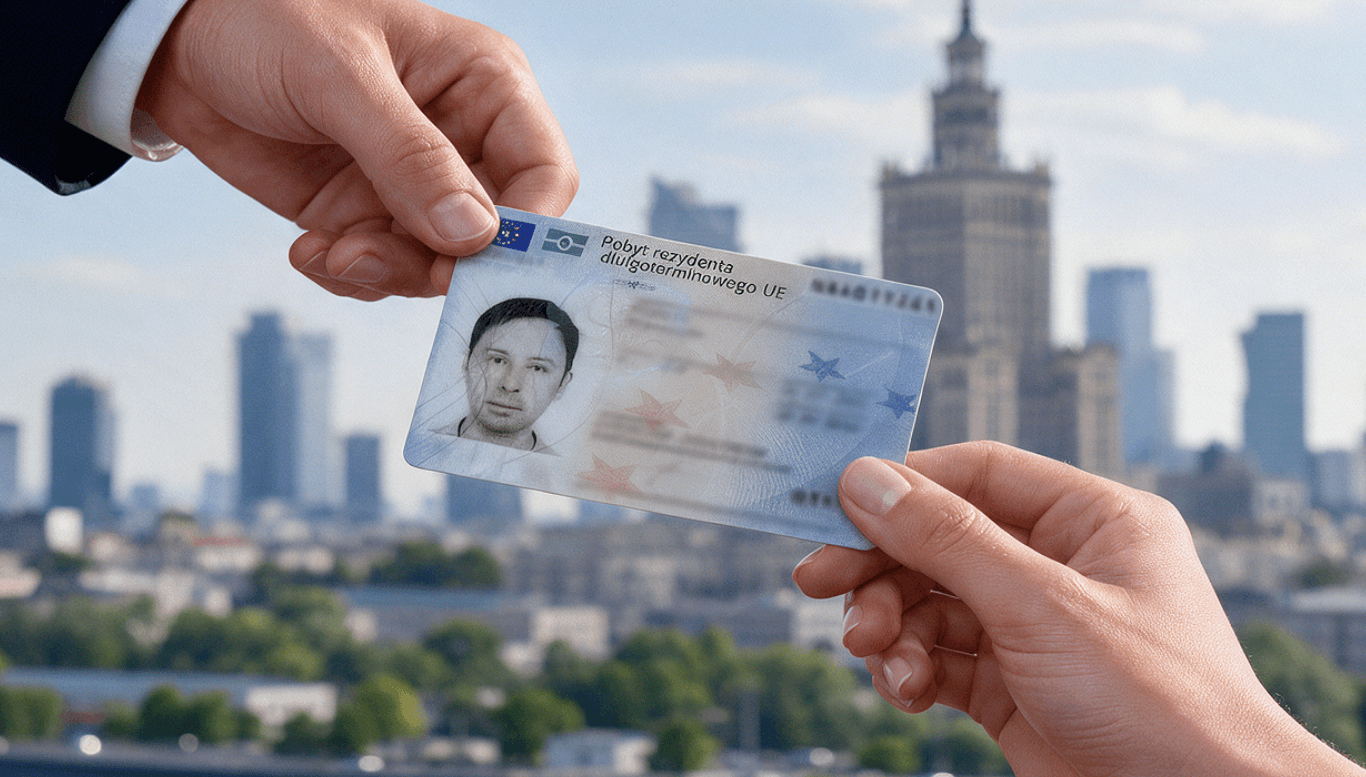
The EU long-term resident permit (zezwolenie na pobyt rezydenta długoterminowego UE) is an indefinite residence permit for nationals of countries outside the European Union. As a rule, it can be obtained after at least five years of legal and continuous residence in Poland, provided other conditions are also met.
The main difference from a temporary residence permit lies in its duration of validity. The EU resident permit itself is issued indefinitely, meaning it does not need to be renewed every few years and there is no need to reconfirm the grounds for residence.
Indefinite does not, however, mean that the permit cannot be lost. It may be revoked in the circumstances specified in Article 215 of the Polish Act on Foreign Nationals (Ustawa o cudzoziemcach). For example, if it was obtained unlawfully, if the person was absent from Poland for more than six years or from the EU for 12 consecutive months. For certain categories - including specified holders of the EU Blue Card - a different maximum period of absence from the European Union applies, namely 24 months.
The physical residence card must be replaced every five years, but replacing the document does not entail repeating the entire permit application procedure.
EU long-term resident status is based on European Union law, including Directive 2003/109/EC. This is precisely why its benefits are not limited to residence in Poland alone.
What Rights EU Resident Status Confers
The first advantage is unrestricted access to the Polish labour market. The holder of this status may work without a separate work permit, change employers and conduct business activities in Poland, including registering a sole proprietorship through CEIDG.
The right of residence is not tied to a specific employer. A change of job or a temporary period without employment does not in itself constitute grounds for revoking the EU resident permit. By comparison, some temporary permits are linked to a specific purpose of stay - for example, employment - and a change in circumstances may require additional steps.
The second advantage is wider opportunities for residence in other EU member states. Long-term resident status enables the holder to apply for residence exceeding three months in another EU state that applies the relevant provisions of European law. The grounds may include work, study, vocational training or other circumstances covered by those rules.
This does not mean an automatic right to relocate to another country and immediately start working there. The requirements of the destination country must be met. Depending on the country and the purpose of stay, a residence permit, proof of income, health insurance and other documents may be required.
EU resident status thus broadens the possibilities for relocation but does not equate a foreign national with an EU citizen in matters of freedom of movement and employment.
Furthermore, the holder of a valid EU residence card, together with a valid passport, may travel to other Schengen Area countries for up to 90 days in each 180-day period without the need for an additional short-stay visa. The status also provides enhanced legal protection in matters of enforced return.
The principal value of the permit therefore lies not only in its duration, but also in the independence of the right of residence from any specific employer and in the broader possibilities for long-term planning.
EU Resident vs Permanent Residence: What Is the Difference
EU long-term resident status and permanent residence (pobyt stały) share certain features. Both permits are indefinite and entitle the holder to work in Poland without a separate work permit.
The fundamental difference lies in the grounds for obtaining them.
Permanent residence is most commonly linked to circumstances specified by law: Polish descent, the Card of the Pole (Karta Polaka), family ties with Polish citizens or other specific grounds.
EU long-term resident status is based primarily on the length and nature of legal residence in Poland. It does not require Polish descent or family ties with Polish nationals. What is required instead is confirmation of the appropriate period of residence, stable income, health insurance and knowledge of the Polish language.
A further difference concerns the possibilities for residence in other EU member states. Long-term resident status provides a specific mechanism for relocating to another member state under established conditions. Polish permanent residence alone does not provide such a mechanism.
The choice therefore depends above all on the legal grounds on which a given person may apply for the respective permit.
Principal Conditions for Obtaining the Status
To obtain an EU long-term resident permit, several core requirements must be met simultaneously.
The first - at least five years of legal and continuous residence.
This refers to the period immediately preceding the submission of the application. Continuous residence does not mean that no travel outside Poland is permitted during the five years.
As a general rule, no single absence should exceed six months, and the total duration of stays abroad should not exceed ten months over the five-year period. The law also provides for exceptions in certain circumstances, such as business trips or specific personal reasons.
It is important, however, to consider not only the length of residence but also its legal basis. Not all periods of legal residence are counted in the same way.
For example, time spent in Poland on the basis of a permit issued for study at a higher education institution is, under specified conditions, counted at half its actual duration. Certain types of stay are not included in the required period at all. Specific rules also apply to EU Blue Card holders regarding the counting of periods of residence in other EU member states.
Five calendar years of life in Poland therefore do not always equate to five years of qualifying residence for the purposes of EU resident status.
The second condition - a stable and regular source of income.
What is required is not merely having a job at the time of application, but demonstrating that the income was lawful, regular and sufficient to support oneself and any dependent family members.
As a general rule, income is assessed over the three years preceding the application, as well as during the processing of the case. For certain categories of highly qualified workers, this period is two years.
For income received from 1 January 2025, the following thresholds have been established:
- above PLN 1,010 net per month for a person living independently with no dependants;
- above PLN 823 net per month per family member - for a shared household.
This is not a requirement to earn a high salary. The key is to demonstrate sufficient, lawful and reasonably stable income over the required period.
The third condition - health insurance.
Insurance providing coverage for medical treatment costs in Poland is required. This may be appropriate coverage under the NFZ system or other confirmation of medical cost coverage as provided for by law.
The fourth condition - knowledge of the Polish language at least at B1 level.
A conversational level of Polish is insufficient. Knowledge must be confirmed by a document from a list defined by law.
This may be an appropriate language certificate or a document confirming the completion of a specified type of education conducted in Polish. However, not every diploma or certificate is accepted. In particular, for applications submitted after 30 June 2026, a certificate of completion of a szkoła policealna (post-secondary vocational school) is no longer accepted as confirmation of language knowledge under the general rule. Transitional provisions apply to certain cases commenced earlier.
The requirement to confirm Polish language knowledge does not apply to children who had not yet reached the age of 16 on the date of application.
Whether Years of UKR Status Are Counted
For Ukrainians residing in Poland on the basis of temporary protection, it is important to correctly establish from which point the required five-year qualifying period begins.
Time spent in Poland on the basis of UKR status is not counted towards the five-year period required for an EU long-term resident permit. Temporary protection status itself is also not a ground for applying for such a permit.
This means that even several years of legal residence in Poland under UKR status do not accrue the qualifying period for EU resident status.
The situation is different with the CUKR card - a special temporary residence permit for certain categories of Ukrainian nationals and their family members who held temporary protection.
The Office for Foreigners of Poland has officially clarified that the period of residence on the basis of the CUKR card is counted towards the qualifying period for an EU long-term resident permit. The qualifying period begins from the date of obtaining the CUKR card, not from the date of acquiring UKR status.
At the same time, if prior to obtaining UKR status or during other periods the person resided in Poland on other lawful grounds, these must be assessed separately. Depending on the type of residence and the circumstances, such periods may be counted in full, partially or not at all.
For Ukrainians, it is therefore important to focus not only on the date of first arrival in Poland, but also on what specific lawful grounds of residence were in place during each period.
What to Check Before Submitting an Application
EU long-term resident status may be the next step in the legalisation process for those planning to remain in Poland for an extended period. Before beginning the formalities, however, it is worth assessing whether your situation meets the basic requirements.
First, check which periods of residence count towards the required five-year qualifying period and whether you have exceeded the permitted total duration of stays abroad. Separately, analyse your income over the relevant years, your health insurance cover and the document you intend to use to confirm your knowledge of Polish.
If you have made use of temporary protection or changed the basis of your residence, pay particular attention to the calculation of the qualifying period. It is this that determines when you will be eligible to apply for an EU resident permit.
The principal advantage of this status is the possibility of obtaining an indefinite right of residence in Poland that is independent of any specific employer. For those who are building their future in Poland, this means greater stability and the ability to plan work and life over a long-term horizon.
For information on current Gremi Personal vacancies and employment conditions, call: +380 50 334 93 51, +48 525 275 003.


 2026-10-15

 View