Ukrainians Watch Russian YouTube Twice Less Than Before the War – Research
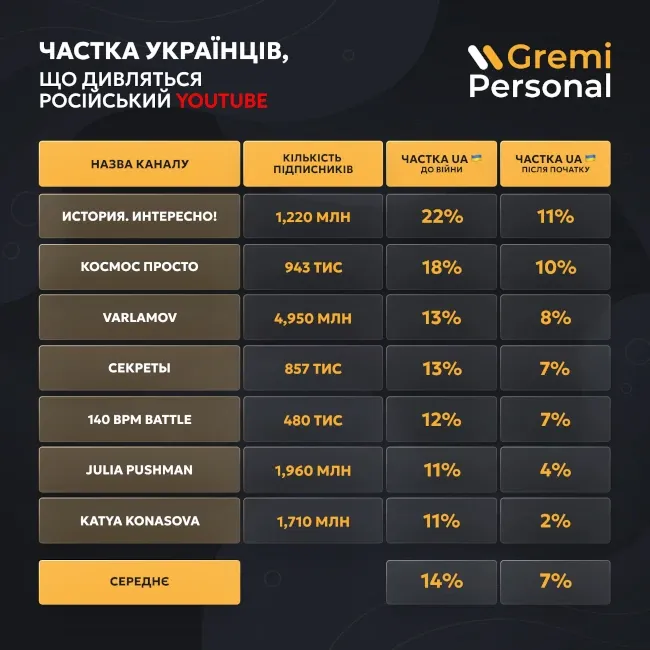
Before the full-scale invasion, the share of Ukrainian viewers of Russian YouTube channels stood at 14%. Two years after the start of the great war, the share of viewers from Ukraine dropped by half — to 7%. This was reported by the analytical center of the international recruitment agency Gremi Personal.
Researchers collected YouTube analytics data from nearly fifty of the top Russian bloggers by subscriber count, divided into two groups: pre-war analytics and post-full-scale-invasion data — 2022 and 2024. Channels were selected by topic category: "interviews," "lifestyle," "technology," "automotive." The following categories were taken into account: viewer gender, viewer age, number of video views, and the share of views from Ukraine.
From the selected list, analysts identified 7 matches — meaning the same seven channels had data available for both periods, enabling a more precise measurement of the changes.
The authors share the research methodology:
"Before the great war, working with international influencers, we received advertising placement offers from bloggers, including Russians. We recently found about two dozen old presentations with 2020–2021 analytics. We then needed to obtain fresh, current data. So we split all bloggers into two lists — before the great war and after it started. The third list of seven bloggers, for which we had data from both periods, served as a verification set. The data across all lists were consistent" — says Maxim Pylypenko, strategic communications expert
AUDIENCE
Across the analyzed channels, both before and after the full-scale invasion, the primary viewers of Russian bloggers are men, who significantly outnumber women in audience share. As for the age distribution of viewers, the core audience in the vast majority of cases is 25–34 years old, followed by 18–24, and then 35–44. We can assume that Russian bloggers are watched primarily by young, economically active men, followed by young adults, and then older men.
CHILDREN AND PRO-RUSSIAN CONTENT
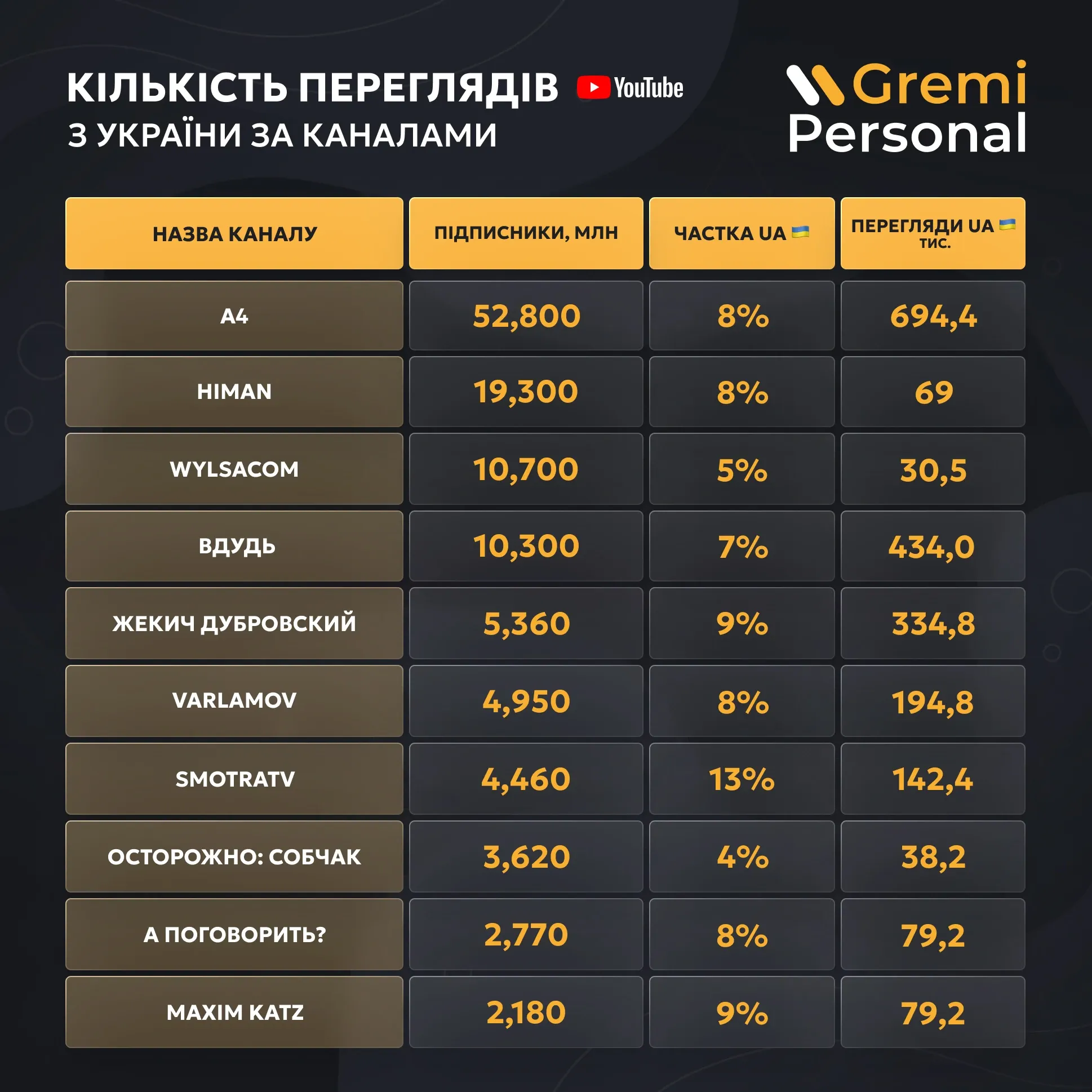
Particular attention was paid to the A4 channel, which has the largest subscriber count among the analyzed bloggers — 52.8M — with an 8% share of views from Ukraine. Despite the fact that Vlad A4 is Belarusian, he occasionally spreads Kremlin narratives, including the claim that Ukraine is part of Russia.
How many Ukrainians exactly watch Russian YouTube in absolute numbers?
Analysts compiled a list of the most well-known Russian channels and calculated the average number of views from the last 10 videos for each channel. It turned out that children consume the most Russian content (Vlad A4 — 694,400 viewers from Ukraine), followed by adults watching interviews (Dud — 434,000), and then car enthusiasts who are fans of Dubrovsky (334,800).
"In the Ukrainian media space, there is a 7% gap through which the Russian world seeps in. The main age group of viewers of the analyzed Russian channels is predominantly men aged 25–34. Children are a non-obvious but vulnerable age group consuming Russian-language content in large volumes. The Russian series 'Slovo Patsana' alone is a prime example — awareness of it has spread across all age groups. Given population size, Russia has a larger absolute number of content creators who flood the market with volume across different categories and for different audiences. That is why every Ukrainian must recognize the need to shield themselves and their children from this media poison" — says Yevhen Kirichenko, founder of Gremi Personal.
"One of the possible ways to protect Ukrainians from Russian content is to switch to English-language content. Russians draw inspiration from Western bloggers' content, which they then adapt for a Russian-speaking audience and infuse with their own narratives. Ukraine should therefore intensify its efforts to teach English. Parents should learn English together with their children and encourage them to watch English-language content for kids" — concludes the study's author, Maxim Pylypenko.
Analysts point out that following the full-scale invasion, more than 6 million Ukrainians left the country and are currently residing abroad — their views are not included in this study. It therefore remains unknown what share of viewers they represented before the war and what they are watching now in their countries of residence.
The following YouTube channels were analyzed in the study: The Curious, Jove, Droider, Zhekych Dubrovsky, Alex Amoral, Sekrety, Tkachov Kostya, Marie Novosad, Retseptu Bon Appetit, Katya Konasova, MASH MILASH, VSRAP, StalinGulag, Masterskaya Sindikata, smotraTV, Istoriya. Interesno!
Kosmos prosto, FORSAZH, Maxim Katz, It's Mamix, Chestny Mikhail, HiMan, A pogovorit'?
Varlamov, 140 BPM BATTLE, Pokashevarim, DZHARAKHOV, Julia Pushman, Vpiska, Wylsacom, Rozetked, Ostorozhno: Sobchak, Nadezhda Strelets, KOVALENKO, вВDud, Zheka Dubrovsky.


 2026-11-03

 View

