Residence Card via MOS: 5 Mistakes When Submitting an Application
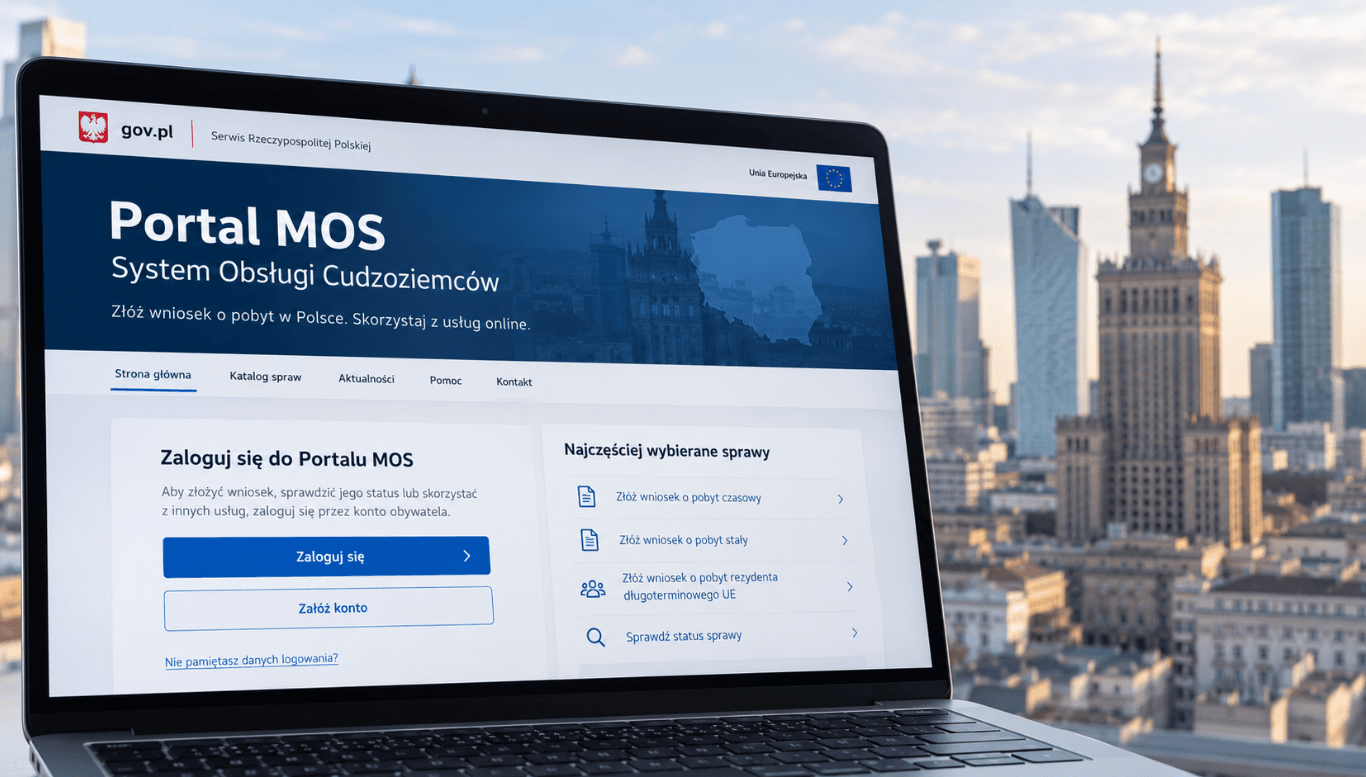 Submitting a residence card application through MOS may seem straightforward at first glance: fill in the online form, attach the required documents and send the application. However, even minor errors, missing data or failure to meet the portal's requirements may constitute grounds for formal deficiencies and delay the further processing of the case. It is therefore important to check the application before it is submitted. Below are the most common mistakes made when applying through MOS, along with explanations of how to avoid them.
What MOS Is
MOS (Moduł Obsługi Spraw - the Case Handling Module) is a government portal through which, from 2026, residence card applications are submitted exclusively online. This applies to both temporary and permanent residence permits (zezwolenie na pobyt czasowy / stały) and to the CUKR card (the residence card for Ukrainian nationals who held temporary protection status). In most cases, a paper application is no longer accepted.
To sign and submit the application, a profil zaufany (trusted profile) or a qualified electronic signature is required. Without one of these, the wniosek cannot be submitted - this is the first technical requirement to have in place before starting the process.
Mistake 1. Incorrect fee amount
The stamp duty (opłata skarbowa) for a residence permit is not the same for everyone. It depends on the purpose for which you are submitting the application. Under the Act on Stamp Duty (ustawa o opłacie skarbowej), the amounts are:
- PLN 340 - temporary residence in standard cases (study, family, other circumstances);
- PLN 440 - temporary residence and work (single permit);
- PLN 640 - permanent residence.
A separate fee of PLN 100 is added for production of the physical card itself (PLN 50 for children under 16 and pupils in full-time education). These are two separate payments, often to different accounts. A typical mistake: the wrong type of fee has been paid, or the second payment has been forgotten. In either case, the application has a formal deficiency and will need to be corrected.
For the CUKR card, the amount is fixed: always PLN 340 + PLN 100, regardless of the circumstances.
Mistake 2. Photo or files not meeting requirements
MOS accepts documents only in a specified format; a file that does not meet the technical parameters will simply not be accepted by the system. Several requirements must be checked simultaneously:
- photograph - in JPG format, at least 684×883 pixels in size, up to 2.5 MB, taken no more than 6 months ago;
- other documents - in PDF format, each file up to 10 MB;
- all attachments combined - up to 50 MB.
The most common reason for rejection is a photograph in PNG or HEIC format (the default format on iPhones), which the system does not accept. Check the format and file size in advance.
Mistake 3. Incomplete passport scan
Under MOS requirements, scans or photographs of all pages of the travel document must be attached to the application - meaning the entire passport, not just the page containing personal data. If not all pages are included, the application is deemed to have formal deficiencies (braki formalne) and is returned for supplementation.
This is a detail easily overlooked in haste, but it can delay the review by weeks. Before submitting, verify that the attachment genuinely includes all pages of the passport, including blank ones.
Please note: for the CUKR card the situation is reversed - UdSC explicitly requests that neither the passport scan nor the PESEL UKR certificate be attached, so as not to slow down processing. The requirements for a standard card and the CUKR card differ in several respects, so verify the requirements specific to your procedure.
Mistake 4. Submission without an electronic signature
A completed form is not yet a submitted application. Until the application is signed electronically (via profil zaufany or a qualified electronic signature), it is not considered submitted - even if everything has been filled in. The same applies to annexes that must be signed by an employer or educational institution: the system sends them a signature request to the email address you have provided, and without their electronic signature the application remains incomplete.
It is therefore advisable to set up a profil zaufany before beginning the process - it can be created free of charge through a Polish bank or at a confirmation point.
Mistake 5. Missing the submission deadline
For a standard residence card, the general rule applies: the application should be submitted while your legal stay is still valid, without leaving it to the last day.
For the CUKR card, the deadline is fixed: 4 March 2027 only. Missing this deadline permanently closes the possibility of using this procedure.
Check Before Submitting
- The correct fee amount for your type of card, and do not forget the separate PLN 100 payment for the physical card. Attach confirmation of both payments.
- A JPG photograph, 684×883 pixels, up to 2.5 MB, taken no more than 6 months ago.
- All attachments in PDF format, totalling up to 50 MB.
- For a standard card - scans of all passport pages (for CUKR, the passport is not attached).
- Whether you have a current profil zaufany or another electronic signature.
The majority of rejections at the MOS submission stage are not caused by complex legal reasons, but by minor formal deficiencies: the wrong fee amount, the wrong photo format, an incomplete passport, an unsigned application. All of these can be verified in a few minutes before submitting. If you are applying for a card for the first time or are uncertain about your particular case - check the requirements specific to your procedure, as they differ in certain respects between a standard card and the CUKR card.
Looking for work in Poland with transparent employment arrangements and support at every stage? Job vacancies across Poland and Europe: +380 50 334 93 51, +48 525 275 003.


 2026-11-12

 View

