What You Need to Know About Fines in Poland
What is an administrative fine?
Traffic fines: for drivers, passengers, and pedestrians
Why you should never ignore fines in Poland?
It's always better to follow the rules, but if you've already broken one — be prepared for the consequences and accept the penalty calmly. Fines abroad can come as a surprise, since some laws differ significantly from what you're used to. On top of that, foreigners often don't speak the local language, and the language barrier is frequently the reason for unintentional violations of Polish law (for tips on how to learn Polish quickly, read here).
Not picking up after your dog, or walking it in the wrong area? Disturbing public order? Not paying taxes on time?
We have bad news: there are consequences for this kind of violation, and you can be fined.
So, what offences can result in a fine in Poland? What can you do if you disagree with the penalty? What can affect the size of a fine, and how do you avoid making things worse if you've already been fined?
Read on to find out.
What is an administrative fine?
Administrative fines in Poland include:
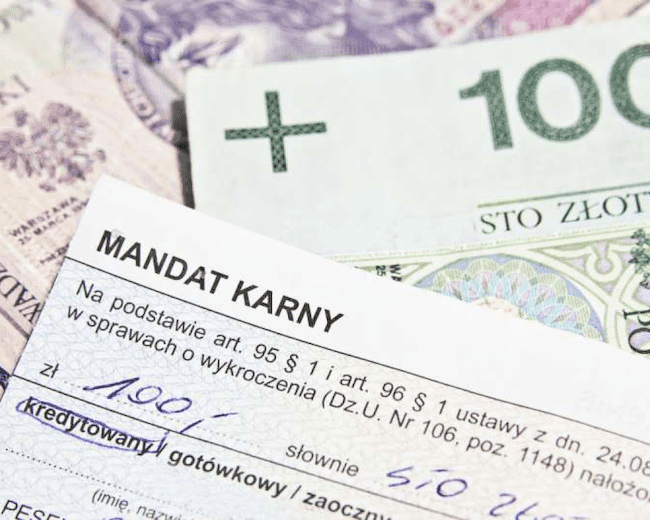
- mandate karny – a fine for violating the provisions of the Petty Offences Code;
- kara administracyjna – an administrative penalty for violating the Code of Administrative Procedure;
- monetary penalties for violations of tax regulations, local authority resolutions, environmental legislation, and more.
If you have violated one of these provisions, you will receive a penalty notice. It most commonly takes the form of a paper receipt or ruling, which is either handed to you in person or sent by post.
The penalty notice will contain:
- the grounds for the fine,
- the amount due,
- payment details.
The payment deadline is typically 7 days, though for traffic fines it can be up to two weeks.
Do you think the fine was issued without grounds? Try to appeal it.
To do so, you need to submit an application to the institution that issued the fine. The penalty may be cancelled if the institution agrees with your arguments. If the case turns out to be complex, it will be referred to a court, which will issue the final ruling.
Traffic fines: for drivers, passengers, and pedestrians
Traffic violations are probably the most common type of fine that Ukrainians encounter in Poland. And it's not just drivers — but let's start with them.
The first thing to note: in addition to a fine, a driver also receives so-called penalty points for traffic offences. The limit is 24 points, and for drivers with less than one year of experience, only 20. If you accumulate too many points, your licence is revoked. This is arguably a more unpleasant consequence than the financial penalty itself.
Speaking of which — Polish police recently reported a dubious record. In the Lublin region, officers stopped a BMW driver for speeding and overtaking on a pedestrian crossing. The man was issued a fine of 1,900 PLN and received 21 penalty points — a record number. Sadly, the offender turned out to be a forty-year-old Ukrainian. We sincerely hope he learned a hard lesson.
 That said, it's not only Ukrainian drivers who break the rules. Another very common offence is fare evasion on public transport.
The fine for travelling without a valid ticket is imposed by the transport company providing the service. However, this doesn't make it any less serious — if you don't pay, the carrier can take you to court or refer your case to a debt collection agency.
A fare evasion fine usually amounts to 150–250 PLN. If you pay quickly, you may receive a discount. It is strongly inadvisable to "forget" about the fine. The statute of limitations for these offences is 1 year, after which the case can be referred to court, and interest and court costs will be added to the original amount. The total sum can end up several times higher.
If you fail to pay a court-ordered fine, the money will be collected by the tax authority directly from your bank account — and the amount will increase further, with a handling fee added on top.
Some Ukrainians are surprised to learn that pedestrians are also required to follow traffic rules. Polish law prohibits crossing the road at unauthorised points and using a phone while crossing — and these violations can result in a real fine. It's best not to test your luck: firstly, it's a matter of your own safety; and secondly, large and small cities alike are full of cameras, so don't count on an offence going unnoticed.
We'd also remind you that cyclists, motorcyclists, and riders of other vehicles are full participants in road traffic, have their own obligations, and can be penalised for violations.
A good — if obvious — piece of advice: before travelling abroad, familiarise yourself with local laws. It'll save you both stress and money.
So, why should you never ignore fines in Poland?
Here are the likely consequences of not paying fines in Poland.
If a fine is not paid on time — court proceedings begin. The amount of the fine will increase, as you will at minimum have to cover court costs. The most extreme outcome is imprisonment.
If you refuse to comply with a court order regarding a fine — enforcement proceedings will be initiated. The sum will be deducted from your income (e.g. your salary), or your property or bank accounts may be seized.
For late payment of certain types of fines (for example, for violations of tax law), penalty interest is charged.
One more important warning: unpaid fines can result in a ban on entering the country for foreign nationals.
All the information in this article is not meant to frighten you. Consider it a friendly reminder — it pays to know the rules and stick to them. And if you have committed an offence — pay the fine promptly or file an appeal.

In difficult situations, Gremi Personal employees can turn to their personal coordinator. This person helps them settle into life in the country and provides advice on matters related to living and working in Poland.
Gremi Personal produces articles and videos about life and work in Poland. Read, watch, and learn more.
Looking for work in Poland? Browse our job vacancy catalogue.
If you haven't found the right offer — give us a call:
+38 (050) 334-93-51 or +48 525 275 003


 2026-09-24
 View
View