Transporting Children by Car: What Rules Apply in Poland
Car seat or seatbelt?
Exceptions: when children can travel without a car seat
After Russia launched its full-scale invasion of Ukraine, many parents with children relocated to neighbouring Poland. Some crossed the border on foot, others used public transport, and some left the country in their own car. The latter group is quite substantial — a car with Ukrainian plates is now a common sight on Polish roads.
Parents who drive with children should not overlook the road traffic rules in force in Poland. This includes the regulations governing the transport of underage passengers. Ignoring them puts both you and your children at risk.
How can you ensure passenger safety? What violations can result in a fine in Poland? Read on for a detailed breakdown.
Car seat or seatbelt?
 In a recent article on fines we explained why breaking traffic laws in Poland is not worth it. Everyone is held accountable — pedestrians, public transport passengers, and of course drivers.
So there is no good reason to ignore the rules — ultimately, it is a matter of safety.
The first thing to remember: when travelling in a passenger car, all occupants must be fastened with a seatbelt.
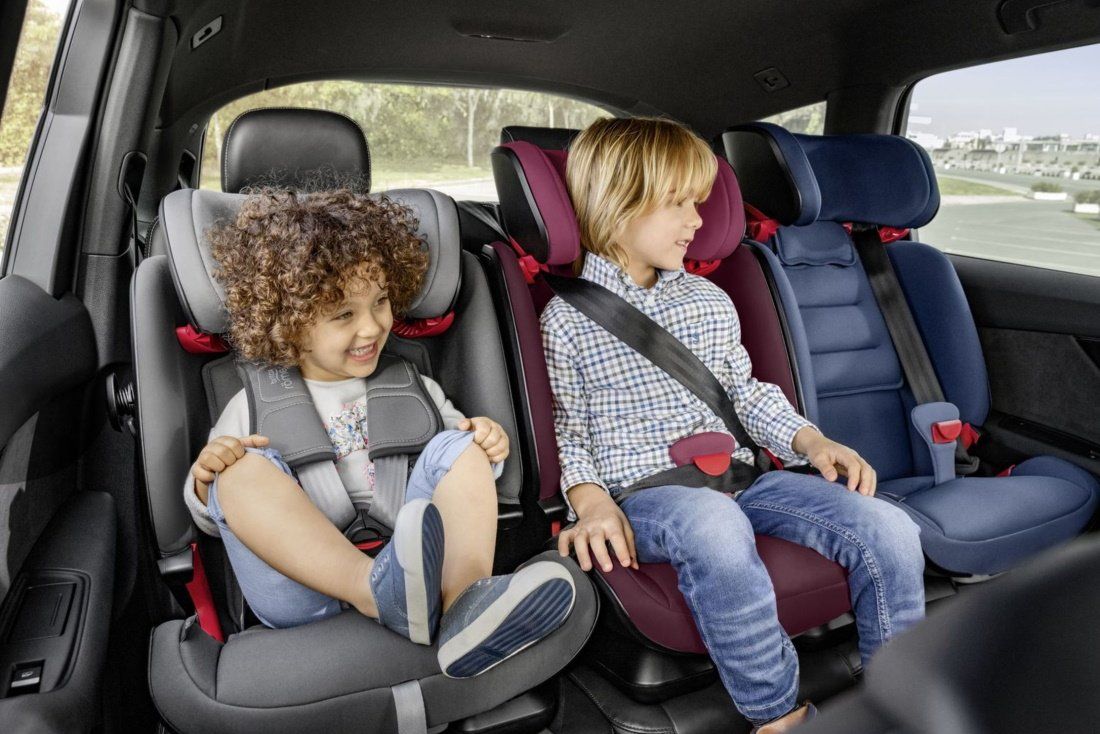
In addition, children must travel in car seats or booster seats. The following rules apply to minors:
- If a child is under 12 years old and their height is below 150 centimetres, they must be transported only in a car seat (in the front of the vehicle), a booster seat, or a special child seat (in the rear). Important: the car seat must match the child's age and weight.
- If a child is under 12 but already taller than 150 centimetres, they may travel on the rear seat of the car. They must, of course, be fastened with a seatbelt.
- If you are the parent of a teenager — a child over 12 years old — you may transport them as an adult passenger: secured with a seatbelt in the front or rear seat. The height of the boy or girl does not matter in this case.
It is worth noting that under previous Polish law, travelling with only a seatbelt was permitted solely for passengers who had reached the age of 12. The current Road Traffic Act has removed this age restriction, allowing younger children taller than 150 cm to travel with the same rights as adult passengers.
Exceptions: when children can travel without a car seat
 Even the strictest rules have exceptions, and traffic regulations are no different.
When it comes to transporting children, there are exactly three such exceptions.
- If a driver is carrying three or more children at the same time and the car does not have enough space to install all the required car seats, one child may be transported without a seat. That child must be at least three years old.
- In some cases, a car seat may harm the child's health, and parents choose not to use one. This is an acceptable reason, but it requires a special medical certificate.
- A child may also use a seatbelt on the rear seat if, due to their physical build (even when shorter than 150 centimetres), it is impossible to provide a car seat of the appropriate size.
Children may also be transported without a dedicated car seat when travelling by taxi in Poland.
What are the consequences of breaking the rules? If you transport a child without a car seat, or the seat is installed incorrectly, you face a fine of 300 złoty. We believe, however, that the key issue is safety — all regulations exist for a solid reason and do not arise out of nowhere.
Take care of yourself and your loved ones, and may every car journey across Poland be a pleasant one!
Gremi Personal publishes articles and videos about life and work in Poland. Read, watch, and discover more useful information.
Looking for a job in Poland? Browse our job vacancy catalogue.
If you haven't found the right offer — give us a call:
+38 (050) 334-93-51 or +48 525 275 003


 2026-11-03

 View

