How the Types of Housing for Ukrainians in Poland Have Changed Over Two Years — A Study
Poland's Ministry of Internal Affairs and Administration announced changes for Ukrainian refugees. These include cutting subsidies for collective accommodation centres from July 2024 onwards. Currently, nearly 40,000 Ukrainians reside in such centres, with the state paying 40 złoty (392 hryvnias) per person per day.
At the same time, the analytics centre of the international recruitment agency Gremi Personal published a study comparing how the types of housing for Ukrainians in Poland have shifted over two years.
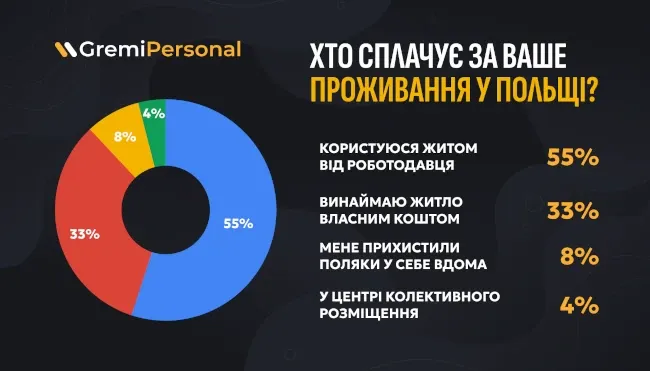
It turns out that in Q1 2024, 55% of Ukrainians stated they were using employer-provided housing, 33% were renting accommodation at their own expense, 8% had found lodging with Polish acquaintances, and just 4% were living in collective accommodation centres.
Interestingly, back in November 2022, when a similar survey was conducted, the distribution of housing types was entirely different.
At that time, 58% of respondents said they were renting on their own, while 22% of Ukrainians had employer-provided housing. 10% were hosted by Polish families, for whom the government paid compensation per refugee under the accommodation programme. 5% were living at state expense (in collective centres) and 5% through the support of charitable organisations.
The survey was conducted via an online questionnaire, with a total of 2,340 respondents across both periods.
Analysts note that the number of Ukrainians provided with housing by their employers has grown nearly 2.5 times compared to 2022.
"Historically, Ukrainians came to Poland for temporary work. At the start of the full-scale war, Poland received the largest number of Ukrainians, many of whom did not immediately enter the workforce. Some had savings, some moved to other EU countries, others returned to Ukraine. In the end, the majority of Ukrainians who stayed in Poland are those focused on working. The number of officially employed Ukrainians in Poland at the end of February 2024 stood at 755,000," explains Anna Dżobołda, Head of Recruitment at Gremi Personal.


 2026-09-24
 View
View