What Documents Are Needed to Work in Poland
 When it comes to official employment in Poland, the paperwork often seems like the most daunting part of the process. The names are unfamiliar, there are many different kinds of documents, and at first glance it is hard to tell what is needed specifically for work and what is for staying in the country.
In practice, it is simpler than it appears. There is no single "universal" set of documents: the required package depends on your situation - on your residence status and the type of contract under which you will be working. The key task is therefore not to gather "everything in sight", but to understand which specific package applies to your case.
There is something else worth bearing in mind: some documents are prepared not by you, but by the employer. You are not required to obtain the work permit yourself or to register in the insurance system on your own behalf.
Below is a checklist to help you confirm what you already have and what is still missing.
What Is Required to Work Legally
Legal employment in Poland rests on three elements that work in conjunction: a basis of stay, a basis for working and a contract. If any one of these is missing, the employment will not be fully legal - even if all the remaining documents are in order.
The first element is the legal basis of stay. This may be a PESEL with UKR status, a visa (other than a tourist visa), a karta pobytu (residence permit decision) or visa-free entry. It is this that grants the right to be present in the country. It is important, however, to understand one thing that is frequently overlooked: the right to stay in Poland and the right to work are not the same thing. Legal residence alone does not constitute permission to work.
The second element is the basis for working. For Ukrainian nationals, this is most commonly the powiadomienie o powierzeniu pracy - a notification of the assignment of work - which the employer submits electronically within 7 days of the start of employment. Depending on your situation, this may also be an oświadczenie (statement on the assignment of work) or a zezwolenie na pracę (work permit). This document is arranged by the employer, not by you.
The third element is the contract. It must be in written form, in a language understandable to the foreign national, concluded before work begins, and its terms must correspond to what is stated in the work permit. It is the contract that governs the rules under which you work: a umowa o pracę (employment contract) or a umowa zlecenia (civil law contract for the provision of services). For a foreign national, a written contract before commencement of work is a statutory requirement, not a matter of the employer's goodwill.
What Will Be Needed for Payments and Registration
Once the basis for work and the contract are in place, what remains is what without which there will be no official salary.
First and foremost, a PESEL - an individual identification number required for insurance registration, tax payments and opening a bank account. This is obtained personally at the urząd gminy (local municipal office) for your place of residence; the number is typically assigned on the day of application or within a few days. It is advisable to obtain a PESEL immediately upon arrival, before starting work - without it, the employer will be unable either to register you with ZUS or to correctly calculate your pay.
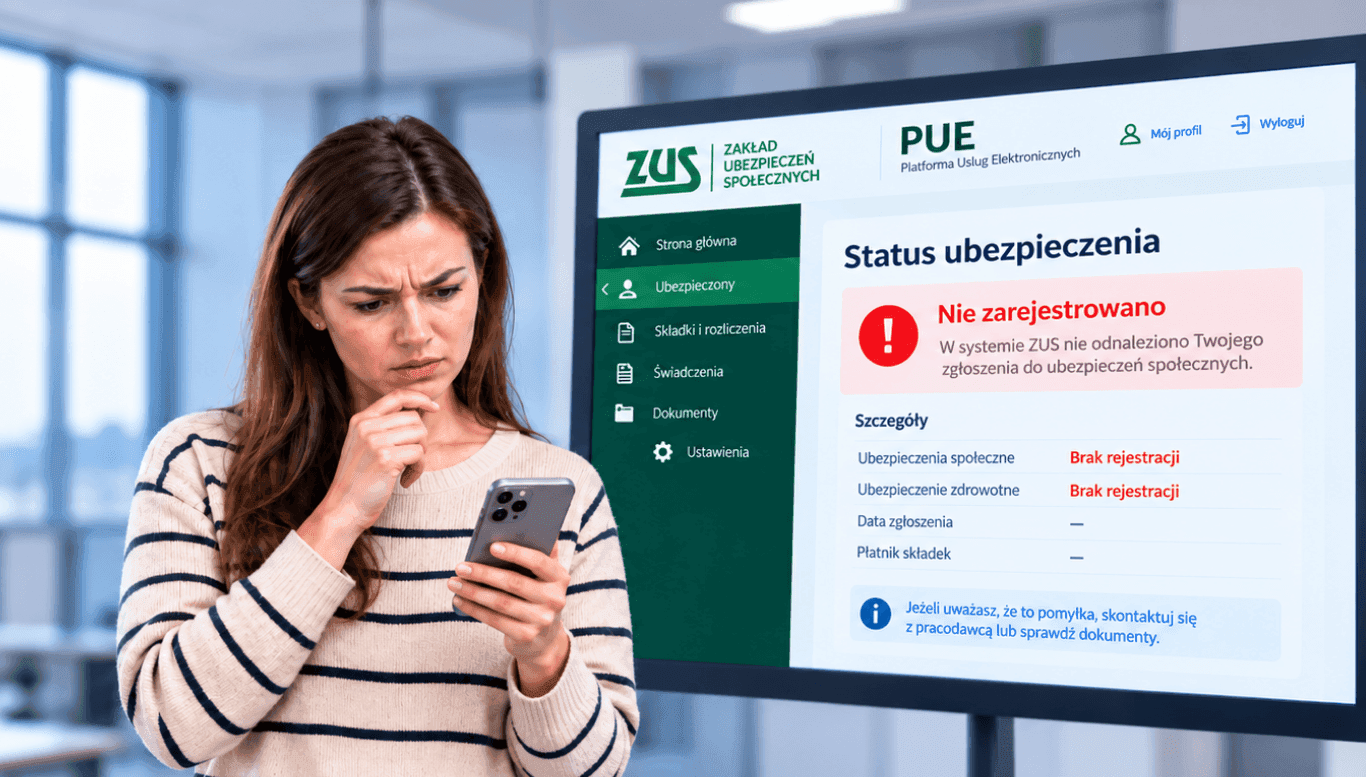
Next comes registration with ZUS (Zakład Ubezpieczeń Społecznych - the Social Insurance Institution), which the employer carries out within 7 days of the start of employment. This is the employer's obligation, not yours. To receive your salary, you will also need a Polish bank account, which you open independently - the bank will typically ask for your passport and PESEL.
Separately, an orzeczenie lekarskie - a medical certificate of fitness for work - is required. Under a umowa o pracę, a medical examination is always mandatory, regardless of the position, and the employer is not permitted to allow you to start work without such a certificate. In certain sectors - primarily those involving work with food, and also, for example, childcare or beauty services - an additional orzeczenie do celów sanitarno-epidemiologicznych is required, more commonly known as a książeczka sanepidowska (health and sanitation booklet).
For some professions, documents confirming education or qualifications may also be needed, and in some cases a certificate of no criminal record. This depends on the specific position, so it is worth clarifying such requirements in advance.
Documents are most conveniently arranged in a natural sequence: first, legal residence and a PESEL; then the basis for work and the contract from the employer; and only after starting work - registration with ZUS and a bank account for salary payments.
Check Your Package
The simplest way to ensure nothing is overlooked is to divide the documents into two lists: what you prepare and what the employer is responsible for.
What you need to prepare:
- passport (travel document);
- legal basis of stay (PESEL with UKR status, visa, karta pobytu or visa-free entry);
- a Polish bank account for your salary;
- documents confirming education or qualifications - if required by the position.
The employer is responsible for:
- the basis for work (powiadomienie, oświadczenie or zezwolenie na pracę);
- a written contract before work begins;
- registration with ZUS;
- a referral for a medical examination (skierowanie) and the orzeczenie lekarskie, where required.
If you can tick off every item on your side of the list, and confirm with confidence that the employer has everything in place before your first shift - this means your employment has been set up correctly.
Documents in Poland are not as complicated as they seem at the outset. The most important thing is to know which package applies to your situation and to understand that the employer has their own obligations to fulfil. When both sides are in order, starting work happens without delays or unwelcome surprises.
Job vacancies across Poland and Europe, official employment, support at every stage. To find a vacancy, call: +380 50 334 93 51, +48 525 275 003.


 2026-09-24
 View
View